

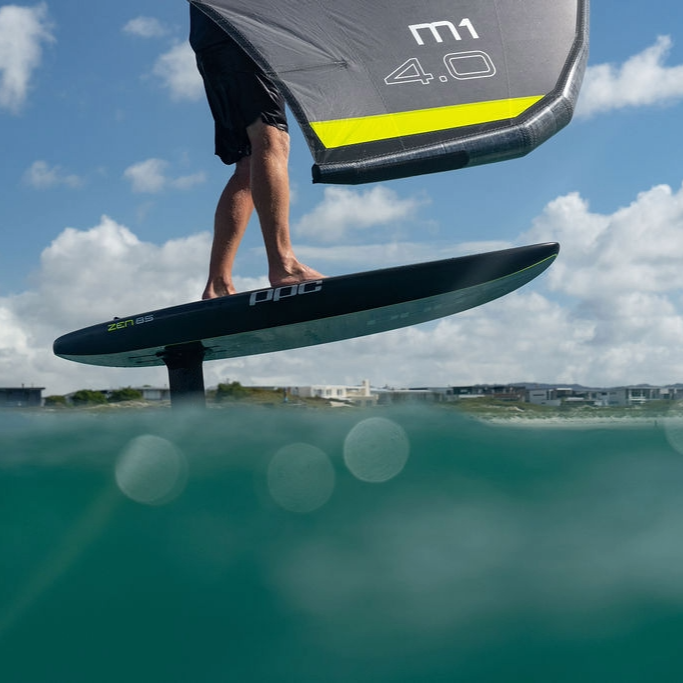
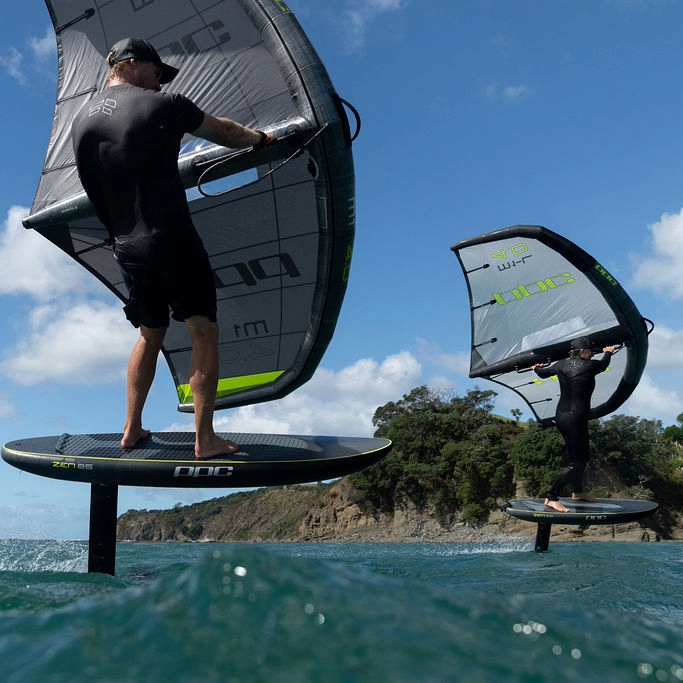
Parawing is the newest discipline in foiling. It's not quite wing foiling, not quite kitesurfing, not quite paragliding — it borrows from all three and lands somewhere new. This guide explains what a parawing is, how it works, how it compares to wing foiling, and what to look for if you're thinking about getting into the category.
Written by the PPC Foiling team, who build the Orbit Parawing — a dual-skin parawing with patent-pending Power Assist Line technology designed for the widest possible wind range.
What is a parawing?
A parawing is a soft, deployable wing flown on lines from the rider's hands. It has no rigid frame — no leading edge tube, no struts, no boom. It packs down to roughly the size of a small daypack and can be deployed and stowed mid-session without coming off the water.
You ride it on a foil board, same as wing foiling. The difference is in the wing itself: a parawing flies more like a paraglider than like a hand-held sail, which opens up a few things that conventional wings can't do.
How parawings work
Three things to understand.
No pump. The wing inflates from wind alone as you move. You deploy it from a stuff sack, feed the lines, and as you start moving the wing fills with air and lifts. Setup time is measured in seconds, not minutes.
Line tension holds the wing. Once flying, the wing is supported by line tension between your hand and the canopy. You sheet in by pulling the lines, sheet out by releasing them. On the right point of sail, you can hold the lines lightly or even let them rest hands-free.
Wide wind range. Because parawings have variable canopy projection, they can adjust to gusts more dynamically than a fixed-shape wing. The Orbit handles 8-35 knots in a single size — covering wind ranges that a wing foil rider would need 3-4 separate wings for.
Parawing vs wing foil
If you ride wing foil already, here's how parawing compares.
Setup. Wing foil — pump up the wing, attach handles, walk to the water. Parawing — pull the wing out of a stuff sack, feed the lines, deploy as you start moving. Parawing wins on setup time. Wing foil wins on consistency of the wing shape.
Wind range. A wing foil quiver covers 12-25 knots across 3 wings (typically 4m, 5m, 6m). One parawing covers 8-35 knots. Parawing wins on coverage.
Handling. Wing foil — direct, immediate feedback. Sheet the wing in, you feel the pull. Parawing — line tension is less immediate, and the wing is further from your hands. Wing foil wins on feel for riding waves and freestyle. Parawing wins on hands-free downwind riding.
Packed size. A pumped wing foil wing has to deflate, fold, and packs into a board bag-sized roll. A parawing packs into a stuff sack the size of a Nalgene. Parawing wins on travel.
Learning curve. Wing foil takes 3-10 sessions to ride consistently. Parawing for a new rider is similar but with a steeper recovery curve — solo deployment in the water needs practice. Wing foil is generally seen as the friendlier learning environment.
Versatility. Wing foil covers wave, freestyle, freeride, racing. Parawing currently shines at downwind and freeride. Wave and freestyle parawing are early days.
Choosing a parawing
The parawing category is new enough that the choice criteria are still settling. Three things to weigh.
Skin construction. Single-skin parawings are lighter and easier to deploy but have less efficiency and lower wind range. Dual-skin parawings (including the PPC Orbit) are heavier but more efficient, with better low-end lift and a wider wind range. Dual-skin is the direction the category is moving.
Line setup. How many lines and how they're rigged affects handling feel. Some parawings use 2 lines, others 4. More lines mean more nuanced control but more complexity. The Orbit uses a configuration designed for hands-free downwind riding while still supporting active control.
Sizing. Parawing sizes map roughly to rider weight + typical wind. A 75-85kg rider in average wind starts on a mid-sized parawing. Because parawings have wider wind range than wing foil wings, most riders need fewer sizes total.
The PPC Orbit Parawing
The Orbit is PPC's first parawing. Designed and tested in New Zealand, it uses dual-skin construction for efficiency and a patent-pending Power Assist Line system for low-end lift in lighter wind.
The headline numbers:
- Dual-skin canopy
- 8-35 knot wind range in a single size
- Hands-free downwind capable
- Packs into a daypack-sized stuff sack
- Patent-pending Power Assist Line (PAL) for low-end lift
Full specs and ordering at ppcfoiling.com/products/ppc-orbit-parawing.
How to learn parawing
Five tips that cut the learning curve.
1. Learn wing foiling first. Most parawing riders come from wing foiling. The board and foil skills transfer directly, leaving only the parawing-specific skills to learn. If you're starting from scratch, that's fine — but expect a longer total learning time.
2. Deploy on land first. Practice opening the parawing from the stuff sack, feeding the lines, and launching the wing on land in moderate wind. Twenty minutes here saves real frustration on the water.
3. Pick a downwind day. Parawings are most forgiving in steady downwind conditions. Cross-shore and gusty days are harder while learning.
4. Use a board you can paddle. A downwind foil board makes recovery and re-launch much easier. A dedicated wing foil board can work but slows recovery.
5. Build re-launch reps. Practice deploying the parawing in the water until it's second nature. This is the skill that separates confident parawing riders from frustrated ones.
Where the category is going
Parawing is early. Most of the gear was launched in the last 18 months. Dual-skin technology is improving fast. Sizing is settling. The hands-free downwind use case is the most-discussed application — kilometres of coastal cruising on a single deployment.
Whether parawing replaces wing foil or sits alongside it is unclear. The honest take: parawing is a meaningful new category, but wing foiling isn't going anywhere. Most serious riders will probably end up with both.
If you're curious, the PPC Orbit is a good place to start. Get in touch via the contact page for sizing advice or to book a demo in Auckland.
Common questions
What is a parawing?
A parawing is a soft, kite-like wing used for downwind and downwind-foiling sessions. It packs down to the size of a small backpack, has no rigid frame, and is held in the hand like a wing foil wing — but it flies more like a small kite. It opens up huge wind range and hands-free downwind running, which is the main appeal.
What's the difference between a parawing and a wing foil wing?
Three differences. First, a parawing has no rigid leading edge or struts — it's a soft, deployable wing, more like a paraglider. Second, it can fly hands-free on most points of sail once it's set, so you can downwind for kilometres without holding it. Third, it covers a wider wind range than a single wing foil wing — typically 8-35 knots with one parawing versus a quiver of 3-4 conventional wings.
How does a parawing work?
The parawing inflates from wind alone — no pump. You deploy it from a stuff sack, feed the lines, and the wing fills as you move. Once flying, line tension supports the wing. You depower by releasing one line, the wing folds, and you stuff it back into the sack. Some parawings (including the PPC Orbit) use dual-skin construction for higher efficiency, and a patent-pending Power Assist Line for low-end lift.
Can I learn parawing without wing foiling experience first?
You can, but most riders find wing foiling experience accelerates parawing learning. The wing-handling instincts, foil control, and rough-water comfort all transfer. Pure beginners can start with parawing — the entry curve is similar to wing foiling, but solo deployment in the water is a real skill that takes practice.
What gear do I need for parawing foiling?
A parawing, a downwind or wing foil board, a hydrofoil setup, and the leashes. The board needs to paddle-up easily — that's why dedicated downwind boards work well. Helmet and impact vest are smart adds, especially while learning.
What size parawing should I start with?
Match the parawing to your weight and local wind. Most riders start with a single mid-sized parawing in the 4-5m range that covers their typical wind. Because parawings have wider wind range than conventional wings, one size often does the job that two or three wing foil wings would.
How is parawing different from kitesurfing?
A parawing has no harness, no bar with safety release, no relaunch from the water in the kitesurfing sense, and no need for an assisted launch. You hold the lines in your hands. It's more like a hand-held mini-kite that can also fly hands-free than it is like a full kite. Far less gear to manage.
Can I downwind run hands-free with a parawing?
Yes — that's one of the headline features. Once the parawing is flying on the right point of sail, you can let line tension hold it overhead and ride hands-free for long stretches. You re-trim by tugging the lines. The PPC Orbit is designed around this hands-free downwind use case.
Where can I buy the PPC Orbit parawing?
Direct from PPC at ppcfoiling.com. The Orbit ships worldwide. You can reserve one with a $100 USD pre-order deposit, or buy outright when stock is available. Auckland customers can collect from the Wairau Valley showroom by appointment.
Is parawing the future of wing foiling?
Honest answer: nobody knows yet. Parawing is the most exciting new category in foiling since wings themselves. Early adopters love the wind range, the hands-free riding and the packed size. Mainstream adoption depends on whether it cracks the learning curve for new riders. Worth watching closely.