

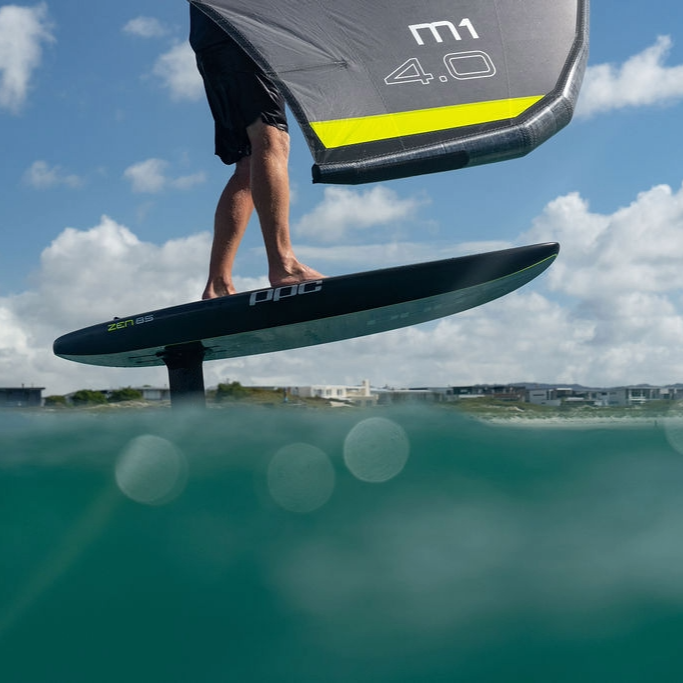
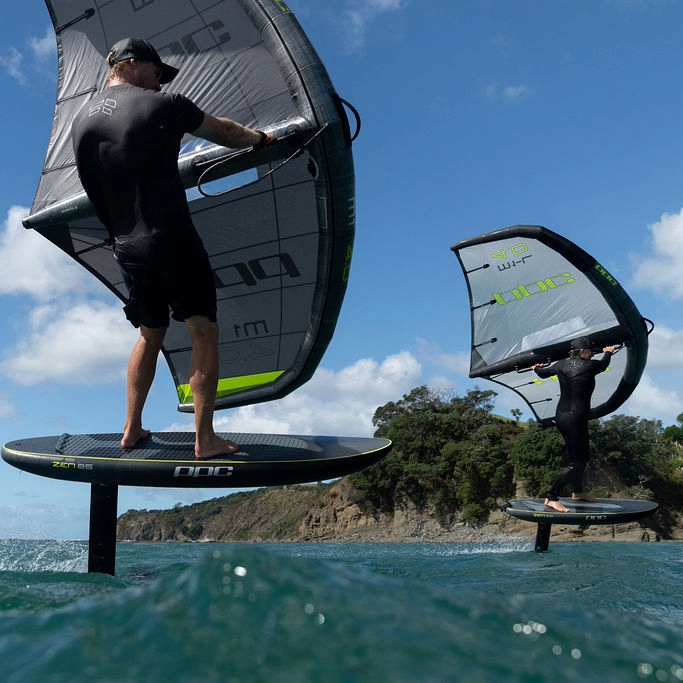
PPC builds a full range of wing foiling wings — from the value-priced M1-L for new riders through to the World Sailing approved Sonic FDS for racing. This guide explains each wing in the range, who it's for, and which one fits your weight, wind and goals.
If you want the short answer: M1-L to learn, M2 to ride everywhere, Sonic FDS to race. Read on for the longer version.

The PPC wing range at a glance
| Wing | Use case | Canopy | Boom or handles |
|---|---|---|---|
| M1-L | Beginner / value | Dacron | Carbon ergo boom |
| M2 | All-round | Premium dacron | Handles or boom |
| M1 | High performance | Thermo-bonded | Carbon boom |
| M1-X | Wave / freestyle | Exo-PE-85 | Carbon ergo boom |
| Vortex SDS | Race accessible | Semi-dual-skin | Carbon boom |
| Sonic FDS | World Sailing race | Full dual-skin | World Sailing carbon boom |
M1-L — for new riders

The M1-L is PPC's accessible-price wing. Dyneema-reinforced frame for durability, carbon ergo boom for handling, dacron canopy. It's built to be forgiving while you learn — predictable power delivery, stable in gusts, easy to recover when you ditch it.
Don't read "beginner" as "compromised". Plenty of intermediate PPC riders keep an M1-L in the quiver for light wind days or when they're loaning gear to a friend.
Best for: first wing, value-conscious progression, demos and lessons. Buy: M1-L Wing.
M2 — the all-rounder

The M2 is PPC's most popular wing and the one most riders progress to after the M1-L. Premium dacron frame, choice of handles or carbon boom, stable but responsive. It covers flatwater cruising, wave riding, freestyle and progression all in one wing.
If you only own one wing, the M2 is the safest single-wing pick across the PPC range.
Best for: intermediate and above, one-wing quivers, riders who do a bit of everything. Buy: M2 Wing.
M1 — high performance
The M1 is the wing that put PPC on the global map. Instant power, smooth precise handling, class-leading upwind speed, thermo-bonded seams for durability. Adam Bennetts called it "the best wing I've used, and I've got pretty much every wing on the market."
The M1 is faster and more responsive than the M2. The trade-off is a slightly less forgiving feel — more performance, more skill required to extract it.
Best for: experienced riders chasing performance. Buy: M1 Wing.
M1-X — lightweight wave / freestyle
The M1-X is the lightweight cousin of the M1. Lighter Exo-PE-85 canopy, ultra-rigid frame, carbon ergo boom. Built for wave and freestyle where every gram matters.
If you're doing primarily wave riding or pursuing freestyle progression, the M1-X is the sharper tool. For all-round riding, the M2 or M1 are more versatile.
Best for: wave-focused and freestyle riders. Buy: M1-X Wing.
Vortex SDS — race accessible
The Vortex SDS is PPC's semi-dual-skin wing — a mid-step between conventional single-skin wings and the full dual-skin Sonic FDS. World Sailing approved, ExoPE-85 frame, carbon boom. More power and upwind capability than the M1, more accessible handling than the Sonic.
For PPC riders who want race-level performance without committing to the full dual-skin Sonic, the Vortex SDS is the bridge.
Best for: ambitious progression riders, club racers. Buy: Vortex SDS Wing.
Sonic FDS — race
The Sonic FDS is PPC's race wing. Full dual-skin canopy, Exo-PE-85 frame, full-carbon World Sailing boom. Higher and faster upwind angles than any single-skin wing in the range. World Sailing approved for Formula Wing competition.
PPC's race team has podium results on the Sonic — Sean Herbert bronze at Formula Wing Worlds 2025, Kosta Gladiadis at the 2026 Formula Wing Europeans, plus the rest of the team running it on tour.
Best for: serious racers. Buy: Sonic FDS Wing.
Sizing across the range
Size selection is the same logic across all PPC wings: match the size to your weight and your typical local wind.
- 60-70kg rider, 15-20kt wind: 4.0m
- 70-85kg rider, 15-20kt wind: 5.0m
- 85-100kg rider, 15-20kt wind: 5.5-6.0m
- Stronger wind: size down. Lighter wind: size up.
Most riders own two sizes — one for typical conditions, one for lighter days. Three sizes covers most of the range.
Demo before you buy
PPC's Auckland team runs demo sessions on the full wing range. If you're choosing between two sizes or two models, demo both. Half an hour on the water beats half an hour reading specs. Book a demo through the contact page.
Common questions
Which PPC wing is best for a beginner?
The M1-L. It's the value-priced wing with a Dyneema-reinforced frame and carbon ergo boom, built specifically for new riders. Forgiving handling, accessible price, and capable enough that you won't outgrow it in three months.
Which PPC wing is best for all-round wing foiling?
The M2. Premium dacron frame, carbon handles or boom option, stable and responsive across a wide wind range. The M2 covers flatwater cruising to wave riding to freestyle. Most PPC riders progress to an M2 after starting on an M1-L.
Which PPC wing is best for racing?
The Sonic FDS — Full Dual Skin. World Sailing approved. Exo-PE 85 frame, full-carbon World Sailing boom, higher and faster upwind angles. PPC's race riders have podium results on the Sonic FDS at Formula Wing Worlds.
What's the difference between the M1 and M1-X?
The M1 is the original high-performance wing — instant power, smooth handling, class-leading upwind speed. The M1-X is the lightweight variant — lighter Exo-PE-85 canopy, ultra-rigid frame, carbon ergo boom, built for wave and freestyle where lower weight matters most.
What's the difference between the Sonic FDS and Vortex SDS?
Both are race-oriented dual-skin wings. The Sonic FDS is full dual skin — higher efficiency, higher top speed, World Sailing approved. The Vortex SDS is semi-dual skin — easier handling, lower weight, still race-capable but more accessible than the Sonic for non-professional racers.
What size PPC wing should I buy?
Match the wing size to your weight and your local wind. A 75-85kg rider in 15-20 knots starts on a 5.0m. Lighter wind or heavier rider, size up. Stronger wind, size down. Most riders end up with two sizes covering 80% of local conditions.
Are PPC wings dacron or dual-skin?
Depends on the model. The M1, M1-X, M1-L and M2 use single-skin canopies (dacron or Exo-PE). The Sonic FDS uses a full dual-skin canopy. The Vortex SDS is semi-dual-skin. Dual-skin canopies are stiffer, faster and more efficient but heavier and pricier.
Do PPC wings come with a boom?
Several PPC wings (including the Sonic FDS and M1 Range) use a carbon boom instead of handles. The M2 is offered with handles or boom. Boom is windsurfing-derived feel; handles are simpler and lighter. Personal preference.
How long do PPC wings last?
PPC wings carry a 6-month warranty on factory defects, with an additional 6+ months available when you register the wing. Properly cared for, PPC wings last several seasons. Wing canopies and bladders are the wear items — replacement parts are available.
Where can I demo a PPC wing in Auckland?
PPC's Wairau Valley showroom runs demo sessions on most of the wing range. Tell us your weight, your typical wind and your goals, and we'll set you up with matched gear for the day. Book through the contact page.