

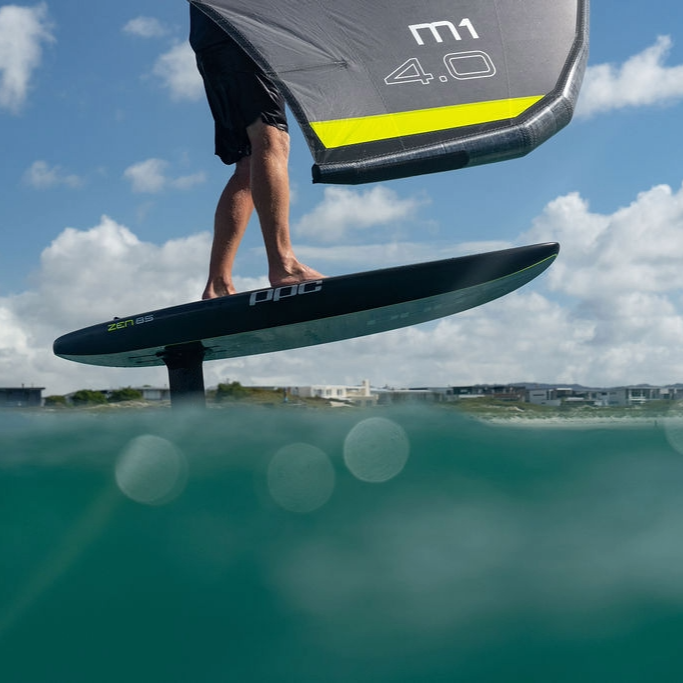
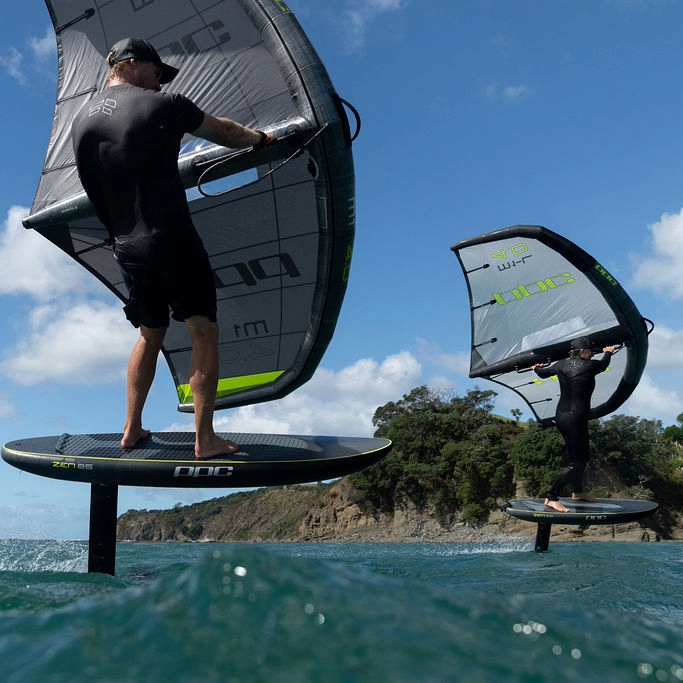
Most wing foil boards look similar from the outside. The construction inside determines how the board actually rides. This guide explains what PPC's MCT carbon construction is, why it matters for performance, and how it compares to the industry standard.
The short version: stiffer boards transmit input cleaner, lighter boards turn quicker, durable boards last longer. MCT delivers all three.

What is MCT construction?
MCT stands for PPC's plug-moulded carbon sandwich construction. Each board is built in a CNC-cut female mould (the "plug") using:
- Full carbon skin layers — top and bottom
- An engineered foam core sized precisely to the mould
- Resin infusion under pressure for consistent density
- Reinforced impact zones at footstrap inserts and the mast track
The plug-mould approach means every board comes out identical — same shape, same stiffness, same response. There's no hand-lay variability between boards.
Why construction matters for wing foiling
Three things matter once you're on the foil.
Stiffness. The board sits between your feet and the foil mast. Every push you make through your feet has to transmit through the board to the foil. A stiff board transmits input cleanly — the foil responds the moment you weight or unweight. A flexy board absorbs the input. You push, nothing happens immediately, then the foil over-reacts a half-second later. It feels sluggish and unpredictable.
Weight. Once you're on foil, the board is in the air. Lighter boards turn quicker, accelerate harder, recover faster from minor mis-positioning. The difference between a 3kg board and a 4.5kg board is huge in terms of feel.
Durability. Foil board impact is real. Foil strikes, board-on-board contact during travel, repeated stress at the mast track. Construction that lasts means the board feels the same in year three as it did in week one.
How MCT compares to typical construction
Most wing foil boards on the market use EPS-and-cloth construction. An EPS foam core gets hand-laid carbon or fibreglass cloth over it, sometimes in a vacuum bag, sometimes not. The construction is faster to build and cheaper, but the trade-offs are real:
- Variable stiffness between boards of the same model
- Lower stiffness for the same weight
- Hand-lay variability means some boards are "better" than others off the same line
- Less impact tolerance at high-stress areas
MCT removes the variability and improves the stiffness-to-weight. The trade-off is build cost — MCT is more expensive to produce than EPS-and-cloth. PPC's position is that the cost is justified by the performance and durability.

The durability case
Sam Loader's view on construction is partly about sustainability. Cheap construction means boards get replaced more often. Better construction means longer product life. Five years of one MCT board beats two-and-a-half years of two cheaper boards — financially and environmentally.
PPC backs the construction with a 5-year warranty on boards. Not many wing foil board brands do that. The warranty isn't marketing copy — it's a statement of belief in the build.
What it feels like on the water
The first time you ride a stiff full-carbon board after riding an EPS-and-cloth board, the difference is obvious. The foil responds immediately. Pumping the foil generates real lift, not absorbed input. Carves feel direct. Small foot pressure adjustments produce immediate foil response.
Riders who upgrade from a standard wing foil board to a PPC board often report that progression accelerates — not because they suddenly got better, but because the gear stopped getting in the way.
Where MCT shows up across the range
Every PPC foil board uses MCT construction.
- Soar and Soar Pro — the wing foil boards
- Link — the downwind board
- Prone Surf — the prone + wing wave board
- ZEN — the mid-length wing and foil drive board
- R1 — the race board
- VOLT — the foil drive board
- UFO Pro — the tow / dock start board
The construction is the same across the range; the outline, rocker and volume change. That consistency is intentional — once you know how an MCT board feels, every PPC board feels like home.
The 5-year warranty
Five years is significantly longer than the industry standard. PPC offers it because the construction supports it. Warranty covers manufacturing defects, structural failure under normal use, and bond integrity. Damage from impact, mast slot leakage from improper care, or sun degradation isn't covered (these are care items, not construction issues).
The full warranty terms are on the warranty page. PPC also offers a 14-day satisfaction warranty — return unused gear in original packaging for a full refund.
See it in person
The construction story makes more sense when you can hold a board in your hands. PPC's Wairau Valley showroom in Auckland keeps the full board range on hand. The team can walk you through the construction details, show you the difference between MCT and typical wing foil board construction, and demo the boards on the water when the conditions are right.
Common questions
What is MCT carbon construction?
MCT is PPC's plug-moulded full-carbon sandwich construction technique. Each board is built in a CNC-cut female mould (the plug) using full-carbon skins and a precisely shaped foam core. The result is lighter, stiffer and more durable than typical EPS-and-cloth wing foil board construction.
Why does board construction matter for wing foiling?
Stiffness transmits input. A stiff board feels fast and direct under foot. A flexy board absorbs energy and feels sluggish. Weight matters once the board is in the air — lighter boards turn quicker and accelerate harder. Construction is what creates both.
How is MCT different from EPS-and-cloth boards?
EPS-and-cloth boards are hand-laid carbon over a foam core, often without a fixed mould. Results vary board to board, and the construction is less stiff for the same weight. MCT uses a fixed CNC mould — every board is identical in shape and stiffness. Full-carbon skins and a specifically engineered core deliver better stiffness-to-weight than typical EPS construction.
Are PPC boards lighter than other brands?
Yes for the same volume class. The Soar in 73L is meaningfully lighter than competing 73L wing foil boards while being stiffer. The VOLT foil drive board comes in near 2.2kg in some specs — exceptionally light for the volume.
Are PPC boards durable?
Yes. The 5-year board warranty backs that up. Carbon sandwich construction handles repeated foil impact, board strikes and travel better than lower-spec construction. Boards still need care, but the construction has proven longevity.
What's the founder's view on construction?
Sam Loader believes durability is a sustainability question. Cheap construction means boards get replaced more often. Better construction means longer product life, less landfill, more value over the years of use. The 5-year warranty reflects that.
Does MCT add cost?
Yes — MCT construction is more expensive than typical EPS-and-cloth. PPC's position is that the cost is justified by the performance, durability and longevity. A 5-year board lifespan at higher upfront cost beats a 2-year board lifespan at lower upfront cost.
Do all PPC boards use MCT?
Yes. The Soar, Soar Pro, Link, Prone Surf, ZEN, VOLT, R1 and UFO Pro all use MCT construction. It's PPC's signature build technique.
Can MCT boards be repaired if damaged?
Yes. Carbon sandwich construction can be repaired by experienced board repair specialists. PPC offers warranty work through the Auckland team and resellers.
Where can I see an MCT board in person?
PPC's Wairau Valley showroom in Auckland. The team can show you the construction details, walk you through how MCT differs from typical wing foil boards, and demo the boards on the water. Book through the contact page.